Saturday, 5 March 2016

Australian bush leaves for dyes

Ecoprinting with Gina in Sydney

Gina Mastio in her garden
in French's Forest, Sydney

Gina Mastio offered to organise a one day course for me and friends during my visit to Sydney last February. I had met Gina in Lauris during an indigo workshop with Michel Garcia and kept in contact with this soft spoken textile artist...
Some of Gina's ecoprint  pieces


So she invited us to her workshop perched in her house right in the tall trees in French's Forest. We spent a fantastic day on the decks in the middle of the vegetation!

Gina has a passion for plants and permaculture. So with the help of Olivier, her French husband, she set up garden beds all over the back yard to feed the family and the dyeing pots!

So we started the day with a tour of the garden and picked a selection of plants, like this purple basil which gave us a beautiful violet hue.


Sally with a generous piece of bark!


Lily Rose loves cooking but this time prepares
 leaves for the dye pots.
We had collected vegetal material over the days to experiment. Sally brought these pieces of eucalyptus bark amongst lots of other Australian plants from her garden! 


We used a wide variety of gum leaves, ferns, bark, nuts, etc. and boiled them in small jars in a bain marie.


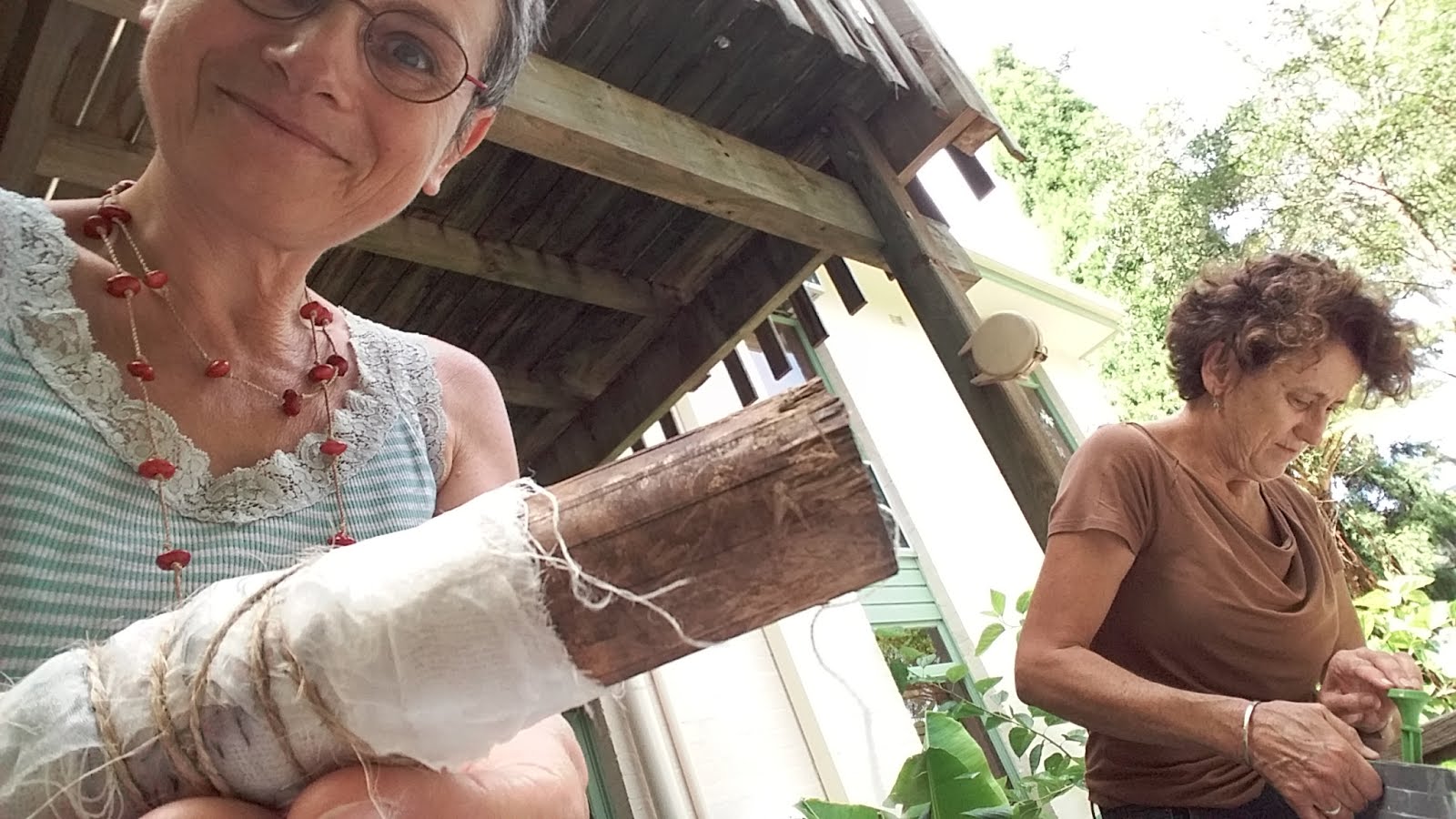
With this array of colours on our swatches, we could now figure out which plant to use for our first eco print pieces. We continued our exploration with bundles. We placed leaves on a silk piece then covered it with a wool piece then bundled the lot like a sanddwich around a tube or stick fastening tightly with rope.


We loaded all these sticks in the big pot, some in the dye bath, partly or whole, some just getting the steam and kept the mixture simmering covered for a good hour. Then comes the surprise to see the result of the combination of minimal planning, random and plant colorings... Cinerea eucalyptus leaves give a lovely bright red;


The next step was to launch into a larger project and dye a scarf of fine merino wool. 

My scarf before folding over and bundling around a bottle.


And the fun comes when you unwrap!


Lily rose, me and Sally
The end of a creative discovery day experimenting with natural dyes in Australia, thanks to Gina!

Saturday, 4 October 2014

A la decouverte de l'impression sur coton

Et surtout de l'utilisation de différents mordants

Michel Garcia maîtrise les techniques des indiennes, comme un pianiste le clavier de son grand piano pour obtenir des teintes et des nuances inouïes. 

Les mordants: la base de l'impression sur coton
Tout d'abord pendant ce stage, il s'agit de préparer une petite série de mordants, qui permettront d'obtenir des couleurs différentes sur une pièce de tissu et dans un même bain. Les ingrédients doivent être soigneusement pesés et mesurés , et le tout noté :c’est la clé qui permettra par la suite de reproduire les mêmes mélanges pour obtenir les mêmes teintes. 

Michel prépare les mordants a base de titane, d'acetate de fer, d'aluminium, etc.
Chaque mordant est ensuite étiqueté
Un pinceau et un tampon carre sont alloues a chaque type de mordant. Attention aux mélanges et bavures. Rien ne pardonne et vous les retrouverez plus tard!
 
On imprime un petit carre de chaque mélange de mordant
 sur un morceau de tissu pour faire un nuancier.


Apres avoir trempe la gamme dans le bain de teinture, 


on découvre les couleurs selon les mordants imprimes sur le tissu.

. Ici, l’échantillon a été teint dans un bain de cochenille.


Apres avoir trempe la gamme dans e bain de teinture, on découvre les couleurs selon les mordants imprimes. L’acétate de fer sert a produire des couleurs sombres, des gris et des noirs.


A Lauris, le jardin de l'Association Couleur Garance est tout près de l'atelier de teinture de l'Association Couleur Garance. Il suffit de descendre sur les terrasses du château pour aller faire la cueillette. Quel bonheur ce jardin de plantes tinctoriales, a présent classe jardin remarquable.

Raid de cosmos fulgurants au jardin de Lauris


Nos échantillons ont été teints dans des bains de garance, de cochenille, de millepertuis, etc. Avec  ces gammes de couleurs,  la planification commence pour dessiner des motifs a imprimer...


Impression avec des tampons de bois
Impression au tampon avec un mordant a base de fer


Rinçage de l’échantillon après teinture dans un bain de tanin.

Des cadres de sérigraphie pour imprimer les cotonnades
Michel et Harumi montrent les 5 cadres qui permettront d'imprimer
successivement les motifs de couleurs souhaitées avec un mordant spécifique.
Première passe avec un mordant fer qui souligne le dessin


Cette pièce sera teinte dans un bain de fruits de khaki verts et de bois de campêche.


Réserves sérigraphiées pour teinture a l'indigo


Un instant de relâche amical au beau milieu de l'effort!
Deuxième passe de réserve pour teinture a l'indigo.


Une ipomée s'approprie un muret dans le jardin de Lauris


Monday, 13 January 2014

Happy New Year Greetings

Ikat silk piece from South Vietnam Khmer village 

Wishing you a very colourful and fulfilling year 2014

Que 2014 soit une année toute en couleur et de bonheur!

Sunday, 12 January 2014

Khmer weaving village in South Vietnam

Sign language to explore memories

Ikat dyed weft


A lady is weaving in the dusty courtyard in the front of the house, two steps away from the street where rice is drying in the sun. We got off our motobikes.


In this village, they practice ikat on silk. After dyeing the silk threads according to a set pattern, they prepare meticulously the bobins which will e bwoven using a bamboo shuttle.

The warp is plain black and they use plain weave.

The design is sufficiently precise to represent temples and elephants and mayn other subjects, but the blurry edges add character to the pieces.
Bobins are carefully organised to ensure
the right pattern formation.


Samy, the weaver and daughter


So I tried to find out what type of dye they use. Eventually, I was shown this swatch of colours and the bags of powder. 


It turns out they buy chemical dyes from Thailand. 


Saon Mamo told me how they dyed silk with plants
Through much sign language and rough translation, I got through to the old couple. 

'In the old days, when you did not have these powders, what leaves and plants did you use to dye the threads?" 


Chau Mom showing a piece of bark
used to dye in yellow. 


The mother, Saon Mamo understood my query. She went straight to a nearby tree and came back with some lleaves. They used to extract green dye from it. 

What about blue?
Blue, they got from far away from the mountains, she said. Red also.

But for yellow, the father, Chau Mom fetched a piece of bark, which turned yellow when he wetted it!

There was a lot of excitment and laughter by the time we took off to return to Chau Doc. Perhaps when I return one day, they will be using their plant dyes again?


Their village of Ap sray skoth, Xa Van Giao, 
South of Mont Sam