Sunday, 12 January 2014

Khmer weaving village in South Vietnam

Sign language to explore memories

Ikat dyed weft


A lady is weaving in the dusty courtyard in the front of the house, two steps away from the street where rice is drying in the sun. We got off our motobikes.


In this village, they practice ikat on silk. After dyeing the silk threads according to a set pattern, they prepare meticulously the bobins which will e bwoven using a bamboo shuttle.

The warp is plain black and they use plain weave.

The design is sufficiently precise to represent temples and elephants and mayn other subjects, but the blurry edges add character to the pieces.
Bobins are carefully organised to ensure
the right pattern formation.


Samy, the weaver and daughter


So I tried to find out what type of dye they use. Eventually, I was shown this swatch of colours and the bags of powder. 


It turns out they buy chemical dyes from Thailand. 


Saon Mamo told me how they dyed silk with plants
Through much sign language and rough translation, I got through to the old couple. 

'In the old days, when you did not have these powders, what leaves and plants did you use to dye the threads?" 


Chau Mom showing a piece of bark
used to dye in yellow. 


The mother, Saon Mamo understood my query. She went straight to a nearby tree and came back with some lleaves. They used to extract green dye from it. 

What about blue?
Blue, they got from far away from the mountains, she said. Red also.

But for yellow, the father, Chau Mom fetched a piece of bark, which turned yellow when he wetted it!

There was a lot of excitment and laughter by the time we took off to return to Chau Doc. Perhaps when I return one day, they will be using their plant dyes again?


Their village of Ap sray skoth, Xa Van Giao, 
South of Mont Sam


Tan Chau famous silk in the Mekong Delta - Lanh My A


Home of mysterious fine black silk


Tam Lang's jacquard looms in Tan Chau,
South Vietnam
Tien, our guide, did find the Tam Lang weaving workshop in the backstreets of Tan Chau. 

I had read that he was the last weaver producing the prized black vervetty silk requiring a lengthy traditional process. 

See Saigon Daily story here on the history of Tan Chau's vibrant silk activities, decline then revival of traditional techniques. This led the famous silk to the catwalks!
Tam Lang wearing black silk


Black dye with Ma Nua fruits
in the Mekong delta
Tan Chau developped a reputation for fine and deep black silk. They dyed the fqbric with the fruit of the Mặc Nưa, or Diospyros mollis Grill. You need to prepare a dye bath with the fruit, dye the fabric then dry it in the sun each day for 45 days in order to get a vrey dark black shade.


Tan Chau est connu pour sa teinture noire, très noire, obtenue a partir des fruits du Mặc Nưa, au nom latin Diospyros mollis Grill. Il faut teindre le tissu dans un bain de fruits broyés puis le faire sécher au soleil et recommencer 45 fois, soit pendant 45 jours avant d'obtenir ce noir profond. 

I enquired if we could watch them dye, but the person in the workshop said they were not ready and didn't have enough fabric to start the dyeing process.

Just like in the story, I admired the beautifully soft and shiny silk fabric and asked if they only produced it in black... History repeats itself. The same comment from a French lady years back, motivated Tam Lang’s son Nguyen Huu Tri to travel around the region and collect recipes for natural dyes in different colours!

Plus d'infos ICI

Silk spooling in Vietnam

Mekong delta meanderings
Tan Chau's silk spooling factory

Tan Chau, a village near Chau Doc by the Cambodian border, had the reputation of the best silk farming and production. 

So off we went on the back of motobikes with our driver Tien, following little roads along canals and among rice paddies.

Tien had done his research the previous night . Here we were, he opened the door of a dull looking buidling from which came a loud mecanical noise... we took our shoes off and stepped into the factor,y in the middle of intense activity. Two floors of spooling machines.

First step, tranfer the threads onto bobins.


Skeins if single silk threads come from Dalat


Skeins of silk threads are now coming from Dalat, in the mountains where they have large scale silk farms. There are unfortunqtely no more mulberry trees in Tan Chau.

In this factory, single silk threads are spooled together in sereval plies, then the process is repeated again and again until the right number of plies.
Constant attention to mend broken threads
Tourist distraction in the
production lines


Dividing the rolls which will become skeins.

Tyeing the skeins together is a matter of skill
using hands and toes.
Skeins of silk threads ready for sale to weaving factories
Smiles from all ages in this busy Tan Chau factory


Sunday, 3 November 2013

Hands on shibori with Yoshiko Wada

Yoshiko Wada explains
intricate shibori techniques in Lauris
Shibori is the memory of folds

Yoshiko launched us into her course with this statement...leaving traces on the fabric. During the International Colour Forum in Lauris this October, Yoshiko held two workshops on Shibori for novices like me.

Folding the fabric regularly, irregularly, or sewing up small sections to prevent parts of the fabrci to enter into contact with the dye: a thousand ways to create textile designs with dyes.

We worked on a piece of silk organza. This very fine fabric is actually fairly stiff for its thickness, because of the presence serecin, a protein substance produced by the silkworms.

Firts we folded the fabric and clamped it with different shapes - I chose the O.


It takes lots of hands to clamp
several pieces together!
Two O plexi shapes are clamped tight on my piece
Then we placed the wetted fabrics in a bath of soda ash.
Contact with the soda ash removed 
the serecin and softened the silk
Yoshiko wraps around my piece for arashi shibori on a PVC down pipe!
Then slides up the fabric tightly and gathers
it in a diagonal direction, tyeing the bundle up with string.
I dyed my piece in a bath of madder, rinsed and dried it.
Then I got carried away and didn't take photos of the arashi result!
Next step, I dyed the piece in indigo and here is the result.

The indigo blue turns out stronger on the serecin ladden spots.
Madder arashi shibori designs come out through the blue in purple brown shades.
Enthusiastic encouraging reaction from Yoshiko
After all these years of experience, Yoshiko still enjoys the surprises of shibori and shares her passion for this technique and natural dyes. 
Watch out it is contagious!

To find out more about Yoshiko's activities here

Friday, 25 October 2013

Slow Fiber Studio Shibori shines in France

Shibori piece from Japan
Shibori from the world over

Lauris staged an exhibition of naturally dyed fine pieces  during the International natural color Forum at Le Jardin de Magali, gallery in the provençal village of Lauris. Yoshiko Wada, heads the Slow Fiber Studios, which promotes textiles and natural dyes internationally.

A variety of styles and techniques to show off contemporary artistic work based on age long skills.


Australian textile artist, Silvia Riley


Silvia Riley, textile designer from Sydney showed colourful pieces dyed with eco print techniques using native tree leaves and plants from Australia.
Ecoprint piece by Silvia Riley


From the United States, Catharine Ellis presented impressive handwoven pieces with different types of thread so dyes take in a different ways according to the fiber forming texture and nuances checkered patterns. In addition, she works sections in shibori. Based in the mountains of North Carolina, Catharine explores woven shibori techniques with natural dyes.
Shibori section from a piece from Catharine Ellis

Catharine Ellis woven shibori piece

A very inspiring exhibition.

Sunday, 20 October 2013

Un bain de couleur au Forum de Lauris

Three days of natural colour immersion in Lauris 


Michel Garcia demonstrates the use of
Indonesian simplocos leaves as a mordant
Couleur Garance successfully organized an international professional Forum and a two day market week end on October 11 to 13 in Lauris. 

Dominique Cardon shared words of encouragement about this rich and informative conference day. Over one hundred professionals from a dozen countries attended  the Forum. See list of speakers HERE.


The conference morning program focused on natural dyes heritage topics. 

Yoshiko Wada, founder of the slow fiber studio in Berkeley US, talked about the art of Shibori design. 

Unicorn tapestry
Cecilia Aguirre from France explained her efforts to convince institutions to use natural colours in textile conservation. She presented probing examples including restauration work on the famous Unicorn tapestry at Cluny Museum in Paris. 


Founders of Bebali Foundation in Indonesia, William Ingham and Jean presented a truly socially responsible conservation project which involved piercing through the well guarded secrets of traditional mordant recipes. They rediscovered the aluminium rich (dead) leaves of the simplocos, a widely spread native rainforest tree and set up collection and retail outlets, and soon export, bringing economic activity to village women in Flores. Another good argument to preserve rainforest against commercial deforestation threats.


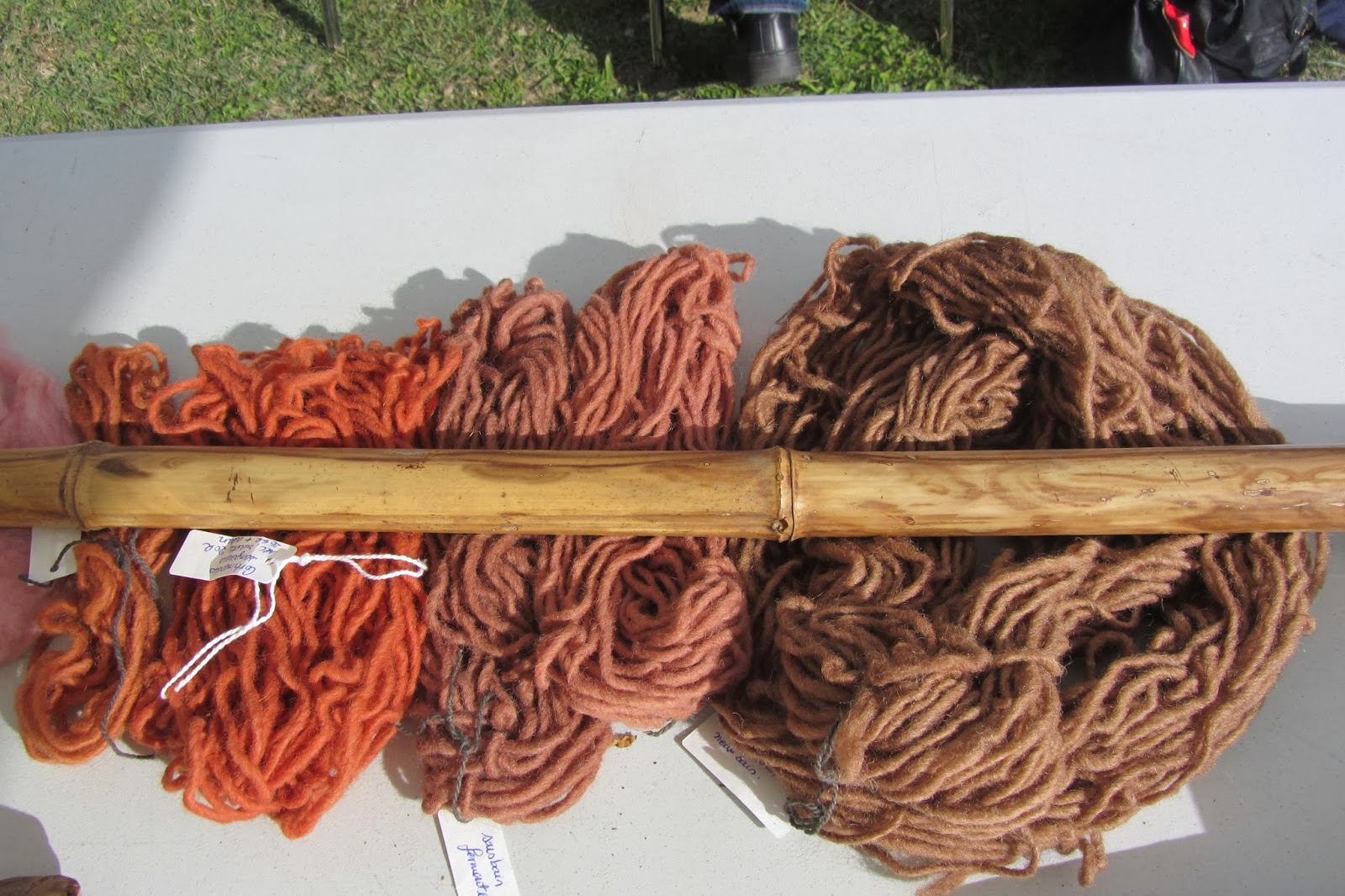
Colorful wool samples dyed with simplocos mordant
Madder dye bath

Afternoon talks included a report on experiments of indigo cultivation in Vaugines, a village near Lauris this summer. They learnt a lot from this first crop of persicaria tinctoria which has produced good quality indigo paste, commercialized by Couleur Garance Association.


Marie Noelle's soft
mauve
scarf dyed
with
mushrooms 
Every one was captivated by the colours Marie Noelle Vachez Granados obtained from dyeing with mushrooms. Astonishing colours!

Mushrooms are a new area for colours. Marie Marquet is undertaking scientific studies on this, see her samples below.

A novel way to look at mushrooms! 
Look but don't lick....


Congratulations to Martine, Soizik, staff and volunteers from Couleur Garance for this priceless series of events.