Showing posts with label hand weaving. Show all posts

Saturday, 16 February 2013

Houey Hong: a Centre to skill up Lao women


Learning and living heritage


Learning to weave complex patterns


The Centre was established in 1998 with grants from Japanese organisations, the Association for Supporting Women and Lao Children, and the Association for Providing Jobs for Lao Women.


As Lao women play a key role in developping the country's economy, the Foundation aims to improve gender equality by assisting skilled women to participate in their communities.

The Centre is all about vocational training, training trainers and reviving Lao traditional crafts such as weaving and dyeing. 

It also established an extensive database of natural dying plants and recorded old patterns and traditional weaving techniques from different regions across the country.
Or drop in at True Colour their shop in Vientiane to see their work.

Now for the professional indigo dyeing workshop


In Laos, silk farms are situated in the North of the country, up in the hills. When the skeins arrive they are first boiled and dried before dyeing.


The indigo comes from Northern Laos.
It's quite a physical job.

Dyeing with ndigo takes time...
Skeins are soaked and stirred in the indigo vat and dried several times to get a darker shade of blue. 

One of the many indigo vats at Houey Hong Centre.


Friday, 15 February 2013

Weaving Legends at Phaeng Mai, Vientiane

Textile workshops hide in gardens and courtyards


This is a fine silk house where concentration and skill reign to perpetuate the traditional textiles of the country.


Silk cocoons can either be white or yellow.


Ebony for grey, betel for brown, anatto seed for orange, 
jackfruit  wood for yellow, lac stick for red (right)...


Raw silk


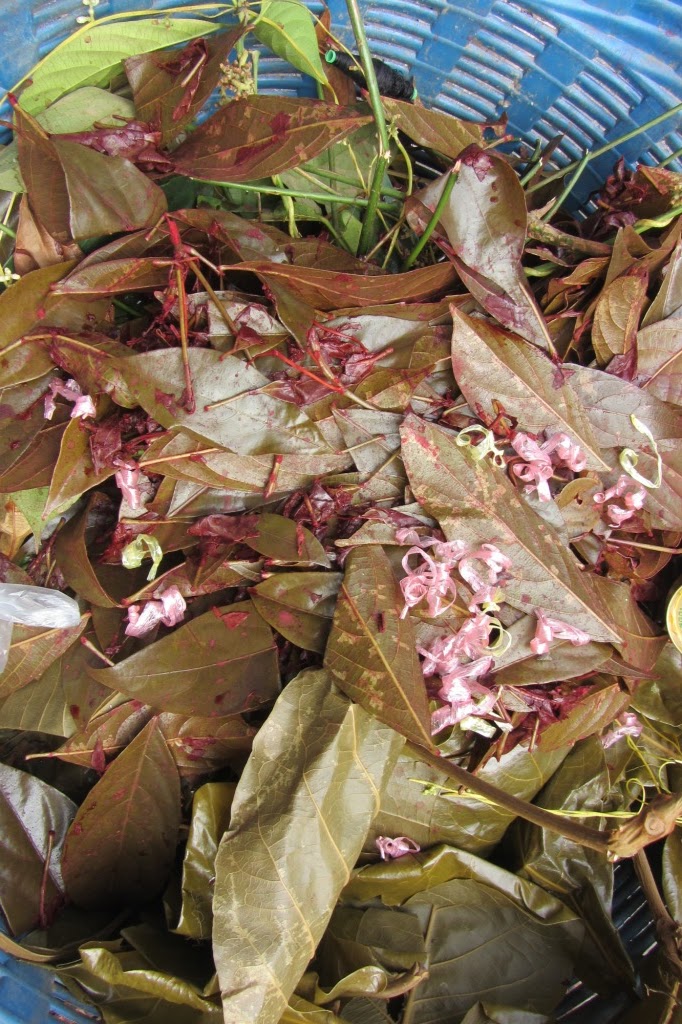
Every picture tells a story, as the content of the rubbish bin, full of used plant material after concoction. Red berries, probably anatto seeds, are set out to dry in the sun. This vat of reddish colour has steaming away for a while ... seeing the pile of burnt charcoal behind it!

Ikat thread preparation


One of the techniques to obtain patterns is to pre dye the motifs on the threads before weaving, so the patterns appear from the weft, or in the case of double ikat from the blend of patterns pre-established on the warp and the weft threads. Ties with plastic string is used to create reserves. Several colours can be applied while adding or removing further ties. This technique requires precision, and also involves a long process...
Removing the tie strings after the dyeing process.

It also takes a skilled weaver to ensure intricate designs form properly. See this eel and flower pattern on a Phuan ethnic skirt. 

Eel and flower pattern on a silk 
Phuan skirt Laos


The blurred edges of the designs had charm to ikat pieces. You can see some fine examples in the Pheang Mai Gallery display room.


Plenty of talented weavers at Pheang Mai

In the workshop, weavers are entirely concentrated on their work. They are masters of dexterity.


Handweaving par excellence - counting warp threads to reproduce patterns on a fine silk piece. (above). Every thread counts!


Reading culture through their traditional clothes

Master weaver and pattern designer for Phaeng Mai Gallery, Viengkham Nanthavongdouangsy
has written this informative book on the sinh, the traditional Laotian skirt.  You will find a lot of information on different weaving patterns and their signification according to areas and ethnic groups.


A wealth of insights in this bilingual book 

It is well worth visiting the exhibition of fine antique pieces above the shop. It's encouraging to see Laotians have kept collections of their textiles.


Threaded warps with weaving patterns are kept for further use. What a library of Laotian textile heritage.


Thursday, 14 February 2013

Museum Material at Taykeo Textiles, Laos

Taykeo -  textile family savoir faire
Out in the Vientiane suburbs, after some hesitation, we finally stopped in front of a leafy garden with a modest sign: Taykeo Textiles Gallery.

Ms Taykeo Sayavongkhamdy opened the door and welcomed us in French in her spacious house. She studied in Paris at La Sorbonne in the seventies. 

Soon, we were ushered upstairs to have a look at a few talented weavers creating wonders on their looms. Seeing that Lao textile traditions were dying out making way for shortcuts to sell simpler pieces produced with chemical dyes, she took a different turn. Taykeo has gone back to natural dyes and intricate patterns to be true to traditional colours and designs her mother would have approved.

Taykeo textiles receives orders from Japan for intricate patterns in subtle patterns and colours.


Keeping Lao tradition alive

A modern piece based on a traditionnal Lao naga pattern

Traditional Lao weaving patterns depict nagas - a mythical snake living in the Mekong River and protectors of Vientiane.  

The space is filled with geometrical nagas  heads, bodies and tails. 


Naga in ikat


Samples from her collection


She has been collecting antique textiles for years and one day would like to display them. For some of the pieces, she has a story to tell. She wore the tube skirt as a child for an important reception.

 "You never wore them twice at important functions', she said.


Gold threads are imported from Lyons, France
Ikat naga design


Such a rich collection deserves to be displayed for textile passionates to enjoy.


Glass cabinets are filled with antique textile pieces, some are over 200 years old.


Give Taykeo a call before your visit and enjoy her commitment to tradtional Lao textiles.